
Greenery as Architecture
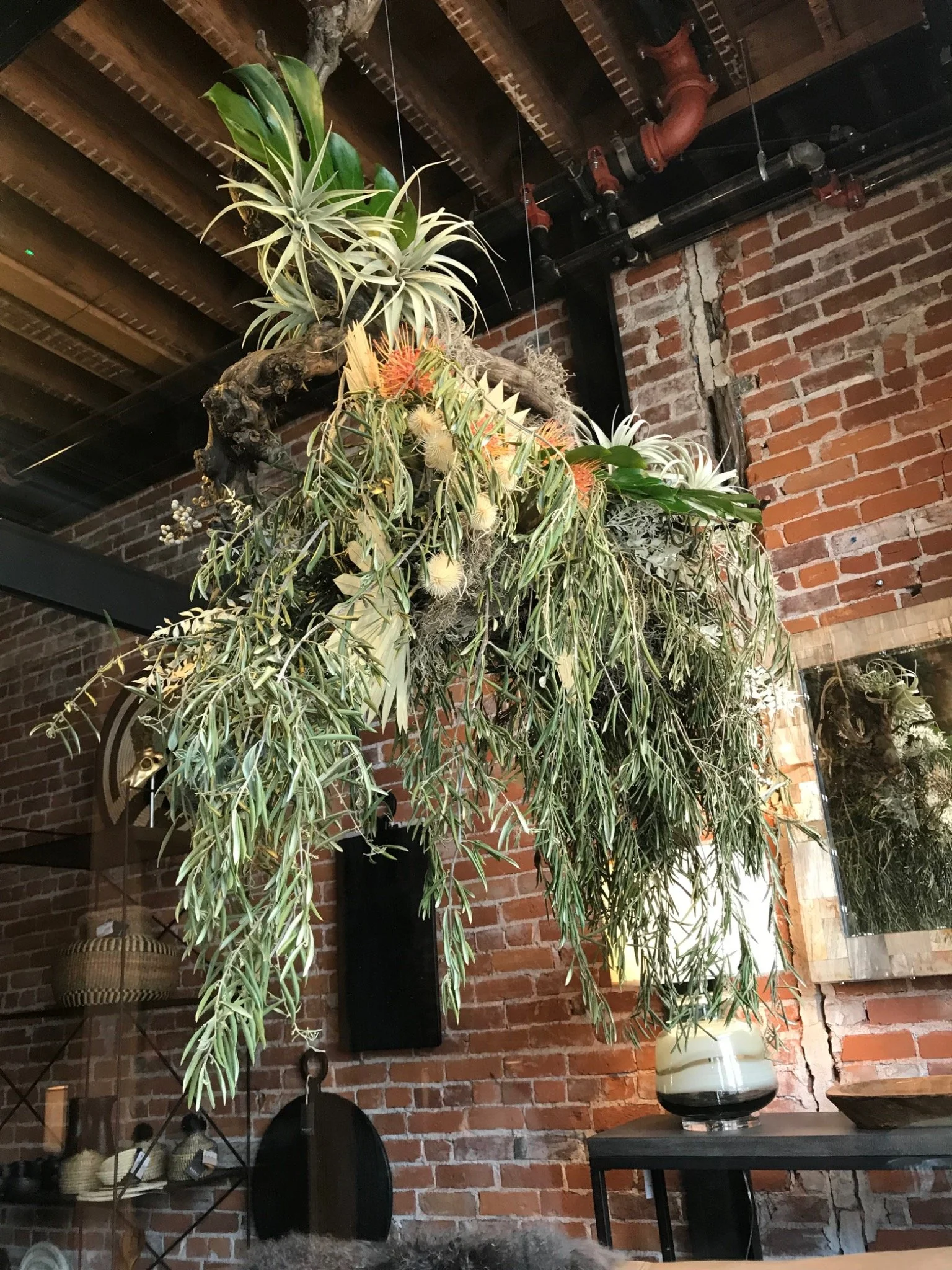
There’s a tendency in interior design to treat greenery as an accessory—something styled at the end, placed politely on a shelf or in a corner. This space rejects that idea entirely. Here, the plant is the architecture.
Suspended from the ceiling like a living chandelier, this sculptural installation transforms a raw industrial interior into something immersive, atmospheric, and unexpectedly soft. It doesn’t just decorate the room—it rewrites how the room is experienced.
When Nature Becomes Structure
At first glance, the setting leans heavily industrial: exposed brick, visible piping, dark steel beams. It’s a language of permanence and utility. But then your eye is pulled upward to something entirely different—a dramatic, asymmetrical mass of greenery cascading from a piece of driftwood.
This isn’t a potted plant. It’s a composition.
Air plants, trailing foliage, and textural botanicals spill downward in layers, creating movement against the rigidity of the architecture. The contrast is what makes it powerful: organic looseness against structural precision.
The Power of Suspension
Hanging elements in a space do something that floor-bound décor never can—they activate vertical volume. Most interiors underutilize the ceiling plane, leaving it as dead space. This installation turns that void into a focal point.
It also shifts how people move through the room. You don’t just pass through—you look up, you slow down, you engage. That’s functional design in a subtle but meaningful way.
For residential applications, this concept translates beautifully:
Over a dining table instead of a traditional chandelier
In an entryway to create an immediate sense of identity
In double-height spaces where scale demands something bold
Texture Over Color
What’s striking here isn’t bright color—it’s restraint. The palette stays within earthy greens, dusty silvers, and muted neutrals, allowing texture to take the lead.
The spiky air plants, soft moss, and trailing leaves each catch light differently, creating depth without visual noise. Even the pops of warm orange blooms feel grounded rather than decorative.
This is a reminder: you don’t need high contrast to create interest. Layered texture often does more work—and feels more timeless.
A Softer Industrial
Industrial interiors can easily skew cold. Hard edges, dark metals, and exposed systems risk feeling unfinished rather than intentional. This installation solves that without diluting the aesthetic.
Instead of adding upholstered softness or conventional warmth, it introduces living softness. The result feels curated rather than corrected.
The greenery doesn’t fight the industrial shell—it elevates it.
Designing With Intention
What makes this moment successful isn’t just the materials—it’s the restraint and clarity of idea. There’s a single, bold gesture executed well.
That’s the takeaway worth applying:
Rather than layering multiple small décor moves, invest in one strong, spatially aware element that defines the room.
Bringing It Into Residential Design
For Canyon Collective’s approach to functional living, this kind of installation aligns perfectly with the idea that spaces should do something, not just look good.
A suspended botanical feature can:
Improve perceived airiness in dense spaces
Create natural zoning without walls
Introduce biophilic benefits in urban homes
Serve as a low-footprint design move (no floor space required)
It’s both aesthetic and spatially strategic.
This space doesn’t just use plants—it gives them authority. And in doing so, it challenges a common assumption in interior design: that the most impactful elements must be built.
Sometimes, the most transformative move is simply letting something grow—then designing the room around it.